


R&D team continuously improves dehumidification technology

Obtained dozens of dehumidification patents

Quickly respond to customer needs

Care for employees, serve customers, and give back to society

Views: 2 Author: Site Editor Publish Time: 2026-07-31 Origin: Site
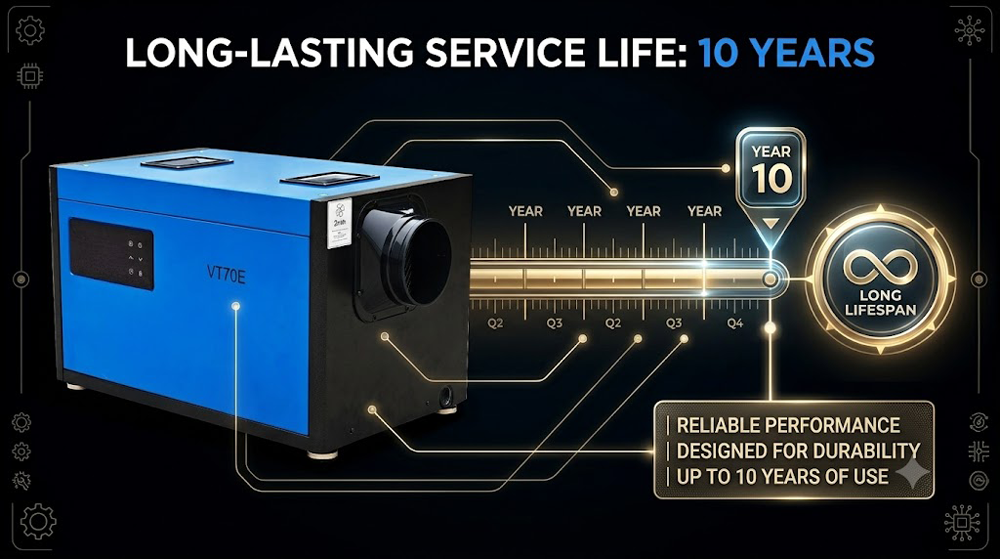
A dehumidifier is an important appliance for controlling indoor humidity, preventing mold growth, protecting building materials, and improving air quality. However, like any mechanical device, a dehumidifier will eventually experience wear and require replacement.
So, how long do dehumidifiers last? In general, most residential dehumidifiers last 5 to 10 years, while commercial and industrial-grade units can often operate for 10 to 15 years or more when properly maintained. The actual lifespan depends on the equipment type, operating environment, usage frequency, maintenance routine, and build quality.
The expected service life varies significantly depending on the design and application of the dehumidifier.
Dehumidifier Type | Average Lifespan | Typical Applications |
Portable Residential Dehumidifier | 3–7 years | Basements, bedrooms, bathrooms |
Whole-House Dehumidifier | 8–12 years | Homes, HVAC systems |
Commercial Refrigerant Dehumidifier | 8–15 years | Warehouses, offices, commercial buildings |
LGR Dehumidifier | 8–15 years | Water damage restoration, construction drying |
Industrial Desiccant Dehumidifier | 10–20 years | Manufacturing, pharmaceuticals, lithium battery plants |
Residential units usually have shorter lifespans because they are designed for intermittent use and lower operating hours. Industrial systems are built with heavier-duty components, corrosion-resistant materials, and continuous operation capabilities.
Several factors determine how long a dehumidifier can operate effectively.
A dehumidifier running occasionally in a dry climate will generally last longer than one operating continuously in a humid environment.
For example:
A basement dehumidifier running a few hours per day may last 7–10 years.
A commercial unit operating 24/7 in a warehouse may require servicing sooner.
A restoration dehumidifier used frequently on flood projects experiences much higher mechanical stress.
Continuous operation is not necessarily harmful if the unit is designed for it. Industrial and commercial dehumidifiers are specifically engineered for long working cycles.
The installation environment has a major impact on durability.
High humidity environments
Constant exposure to moisture can accelerate:
Corrosion of metal components
Electrical component degradation
Coil contamination
Compressor wear
For example, a dehumidifier installed in a coastal warehouse may experience faster corrosion than one operating in a dry inland area.
Temperature conditions
Most refrigerant dehumidifiers perform best within a moderate temperature range. Extremely cold or hot conditions can reduce efficiency and increase stress on components.
For low-temperature applications such as basements, crawl spaces, or cold storage areas, specialized low-temperature dehumidifiers are usually recommended.
Regular maintenance is one of the most important ways to extend dehumidifier life.
Clean the Air Filter Regularly
A dirty filter restricts airflow, causing:
Reduced moisture removal capacity
Higher energy consumption
Compressor overheating
Most filters should be cleaned every 2–4 weeks during heavy operation.
Clean the Coils
Dust and dirt on evaporator and condenser coils reduce heat transfer efficiency. Cleaning the coils annually helps maintain performance.
Check Drainage Systems
Blocked drain lines or malfunctioning pumps can cause:
Water leakage
Internal corrosion
System shutdowns
For commercial applications, routine drainage inspections are essential.
A dehumidifier may still turn on but no longer operate efficiently. Common signs of aging include:
1. Reduced Moisture Removal
If the unit runs continuously but humidity levels remain high, possible causes include:
Compressor wear
Refrigerant leakage
Dirty coils
Fan problems
A significant decline in water collection is often one of the first signs of failure.
2. Unusual Noise
Older units may develop:
Compressor clicking sounds
Fan motor noise
Vibrations
While some noise is normal, sudden changes usually indicate mechanical problems.
3. Frequent Shutdowns
If the dehumidifier repeatedly turns off due to:
Overheating
Sensor failure
Electrical problems
Repair costs may approach the price of replacement.
4. Rising Energy Consumption
An aging dehumidifier may require more electricity to remove the same amount of moisture. Newer models often provide better energy efficiency due to improved compressors, controls, and heat exchanger designs.
Proper care can significantly extend the service life of your equipment.
An undersized dehumidifier must work continuously and may wear out faster.
For example:
Small residential spaces: portable units
Large basements: whole-house systems, crawl space dehumidifiers
Warehouses: commercial industrial units
Selecting the correct moisture removal capacity prevents unnecessary strain.
Avoid placing the dehumidifier:
Directly against walls
Near blocked vents
In dusty environments
Adequate airflow helps the compressor and condenser operate efficiently.
For most indoor spaces, maintaining relative humidity between 40% and 60% is recommended.
Operating at extremely low humidity levels unnecessarily increases runtime and energy use.
Different applications require different technologies.
Refrigerant Dehumidifiers
Best for:
Homes
Offices
Warehouses
Commercial buildings
They are energy-efficient in warm and moderately humid environments.
LGR Dehumidifiers
Best for:
Flood restoration
Water damage recovery
Construction drying
They can remove moisture effectively even at lower humidity levels.
Desiccant Dehumidifiers
Best for:
Pharmaceutical production
Battery manufacturing
Cold storage
Precision manufacturing
They provide ultra-low humidity control and can operate in colder environments.
A replacement is usually worth considering when:
The unit is over 8–10 years old
Repair costs exceed 50% of replacement cost
Moisture removal performance has declined significantly
The compressor has failed
Replacement parts are difficult to find
For commercial and industrial users, replacement decisions should also consider:
Downtime risks
Energy efficiency improvements
Maintenance costs
Production requirements
The average lifespan of a dehumidifier is typically 5–10 years for residential models and 10–15 years or more for commercial and industrial systems. However, lifespan depends heavily on usage conditions, maintenance, equipment quality, and application requirements.
A well-maintained dehumidifier can provide reliable humidity control for many years. Choosing the correct type of unit, keeping filters and coils clean, and operating it under suitable conditions are the key factors that maximize performance and service life. For demanding applications such as warehouses, restoration projects, and industrial facilities, investing in a commercial-grade dehumidification system can provide better durability and lower long-term operating costs.


