


R&D team continuously improves dehumidification technology

Obtained dozens of dehumidification patents

Quickly respond to customer needs

Care for employees, serve customers, and give back to society

Views: 2 Author: Site Editor Publish Time: 2026-08-19 Origin: Site
When buying or building a new house, it is easy to focus on the kitchen, bathrooms, bedrooms, flooring, and exterior appearance. However, one often-overlooked area is the space under the house.
Whether your home has a crawl space, raised foundation, or partially enclosed area beneath the floor, this hidden space can have a major impact on indoor air quality, structural durability, and long-term maintenance costs.
The area underneath a house can be exposed to soil moisture, groundwater, rainwater, and humid outdoor air. If moisture accumulates and remains trapped, it can create a range of problems.
Common signs of an under-house moisture problem include:
Musty or damp odors
Standing water or wet soil
Condensation on pipes and surfaces
Mold or mildew
Damp insulation
Wood discoloration or decay
Rust or corrosion on metal components
High indoor humidity
Increased pest activity
Because the space is often dark and difficult to access, these problems may remain unnoticed for a long time.
If you are purchasing a new house, don't assume that a new building is automatically free from moisture problems.
Inspect the under-house area for:
Look for puddles, wet soil, water stains, or signs of previous flooding. Standing water may indicate poor drainage, groundwater intrusion, plumbing leaks, or inadequate grading around the foundation.
Even without standing water, exposed soil can continuously release water vapor into the crawl space. In humid climates, this can create a substantial moisture load.
Inspect wooden floor joists, beams, and subflooring for discoloration, mold growth, soft spots, or signs of decay. Persistent moisture can eventually compromise wood components.
Wet or damaged insulation should not be ignored. Moist insulation loses effectiveness and can contribute to mold and odor problems.
Check whether the crawl space has an appropriate moisture-control strategy. Simply adding vents is not always enough, particularly in hot and humid climates, where outdoor air can introduce additional moisture.
There are several possible causes.
Construction moisture can remain in concrete, lumber, drywall, and other building materials after construction. If the space is poorly ventilated or dehumidified, this moisture may take a long time to dissipate.
In addition, the house may have:
Poor site drainage
An inadequately sealed foundation
Uncovered soil
Plumbing leaks
Improper grading
Insufficient vapor barriers
Air leakage from the exterior
A new home therefore still requires a proper moisture inspection.
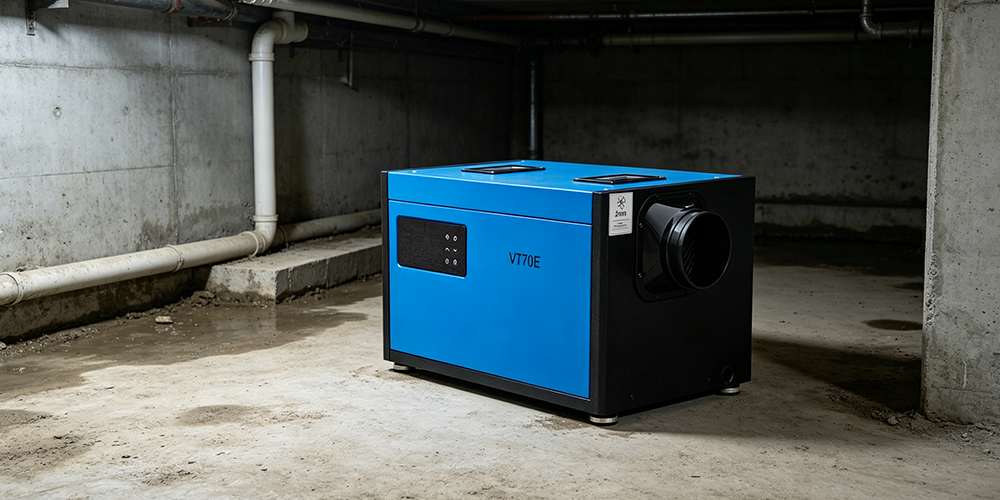
If humidity is consistently high in a crawl space or under-house area, a crawl space dehumidifier can be an effective solution.
An under house dehumidifier removes water vapor from the air and helps maintain a controlled relative humidity level. This can reduce the conditions that support mold growth, wood decay, condensation, and corrosion.
For long-term operation, choose a unit designed for crawl spaces or other confined areas. Important features can include:
Automatic humidity control
Continuous drainage
Compact installation
Low-temperature operation
Washable or replaceable air filters
Corrosion-resistant construction
Remote monitoring or control
A continuous drain is particularly useful because accessing the under-house area frequently to empty a water tank is inconvenient.
A practical target for many crawl spaces is below 60% relative humidity, with approximately 45%–55% RH often being a reasonable operating range.
The exact target depends on the construction, climate, materials, and moisture-control strategy.
A simple digital hygrometer can provide an initial indication of humidity, but a professional moisture inspection may be appropriate when persistent dampness is suspected.
A dehumidifier should not be used to compensate for an active water intrusion problem.
If water is entering from the ground, foundation, roof, plumbing, or drainage system, the source should be corrected first.
A comprehensive moisture-control strategy may include:
Improving exterior drainage.
Repairing plumbing and foundation leaks.
Installing or repairing a ground vapor barrier.
Sealing unnecessary air leaks.
Improving insulation.
Installing a suitable crawl space dehumidifier.
Monitoring humidity regularly.
The objective is not simply to dry the air temporarily but to control the moisture source and maintain a stable environment.
The under-house area is easy to forget because it is out of sight. However, small moisture problems can lead to expensive repairs if they go undetected.
Try to inspect the area periodically, particularly after heavy rainfall, flooding, plumbing repairs, or significant seasonal changes.
Look for new water stains, condensation, mold, unusual odors, damaged insulation, and changes in wood condition.
When buying a new house, don't overlook the space beneath it. The crawl space or under-house area is part of the home's moisture-control system, even though it is rarely visible.
Checking for water intrusion, damp soil, condensation, mold, insulation problems, and excessive humidity can help identify issues before they become major expenses.
If the area is structurally sound but consistently humid, a properly sized crawl space dehumidifier can provide continuous moisture control. Combined with good drainage, vapor protection, and regular inspections, this approach can help keep the house drier, healthier, and more durable for years to come.


