


R&D team continuously improves dehumidification technology

Obtained dozens of dehumidification patents

Quickly respond to customer needs

Care for employees, serve customers, and give back to society

Views: 1 Author: Site Editor Publish Time: 2026-08-05 Origin: Site
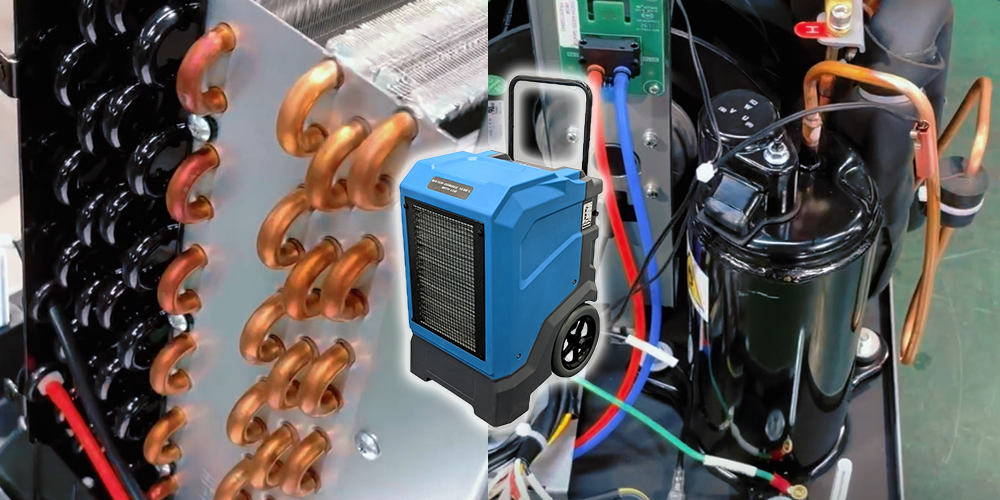
Commercial dehumidifiers are generally repairable, and many units are designed for long-term service rather than replacement after a single failure. Unlike residential models, commercial and industrial dehumidifiers usually use heavier-duty components, modular designs, and replaceable parts, making maintenance and repair economically worthwhile.
Problem | Possible Cause | Repair Solution |
Unit runs but does not remove moisture | Low refrigerant, dirty coil, compressor issue | Refrigerant recharge, coil cleaning, compressor inspection |
Water leakage | Blocked drain pipe, failed pump, improper installation | Clean drain system, replace condensate pump |
Fan not working | Motor failure, capacitor damage, wiring issue | Replace motor or electrical components |
Poor airflow | Dirty filters, blocked air passages, fan problems | Filter replacement, airflow cleaning |
Ice buildup on coils | Low airflow, low temperature operation, sensor failure | Clean filters, repair sensors, check defrost system |
Unit will not start | Control board, power supply, safety switch failure | Replace electronic components |
Excessive noise | Fan bearing wear, loose parts, compressor vibration | Replace worn components and tighten parts |
Commercial dehumidifiers are built with serviceable components, including:
The compressor is one of the most expensive parts, but it can usually be replaced if:
The compressor motor fails
Refrigerant leakage damages the system
The compressor loses efficiency
Technicians can repair or replace:
Evaporator coils
Condenser coils
Expansion valves/capillary tubes
Refrigerant piping
Refrigerant sensors
Common replacements include:
Control boards
Relays
Capacitors
Humidity sensors
Temperature sensors
Contactors
Fan motors
Blower wheels
Filters
Grilles
Repair is usually recommended when:
The unit is less than 8–10 years old
The compressor and heat exchanger are still in good condition
Replacement parts are available
Repair cost is less than 40–50% of a new unit price
Replacement may be better when:
The compressor fails on an old unit
The coil has severe corrosion
Refrigerant leaks repeatedly occur
Control systems are obsolete
Energy consumption is much higher than newer models
Feature | Commercial Dehumidifier | Residential Dehumidifier |
Expected lifespan | 8–15+ years | 3–7 years |
Parts availability | Usually good | Often limited |
Compressor replacement | Common | Often uneconomical |
Service access | Designed for technicians | Limited |
Maintenance frequency | Regular professional service | Basic cleaning |
Commercial models used in warehouses, grow rooms, restoration, indoor pools, and manufacturing facilities are typically engineered for continuous operation, so manufacturers usually provide replacement parts and technical support.
To extend the service life of a dehumidifier for water leak:
Dirty filters reduce airflow and increase compressor stress.
Operating continuously at extremely low RH can increase wear.
Dust buildup reduces heat exchange efficiency.
Blocked drains can cause water damage and shutdowns.
Industrial dehumidifiers often benefit from inspection every 3–6 months.
Commercial dehumidifiers are highly repairable compared with residential units. A well-maintained industrial dehumidifier can often operate for 10 years or more, with major components such as compressors, fans, sensors, and control boards replaceable.
For businesses such as warehouses, factories, restoration companies, and cultivation facilities, investing in a repairable commercial dehumidifier usually provides a lower total cost of ownership than repeatedly replacing smaller units.


