R&D team continuously improves dehumidification technology

Obtained dozens of dehumidification patents

Quickly respond to customer needs

Care for employees, serve customers, and give back to society

Views: 9 Author: Site Editor Publish Time: 2025-11-11 Origin: Site

If your floor is soaked, whether from a leak, flood, or pipe burst, it’s crucial to act fast with the right equipment. Below is a guide to help you choose the most effective dehumidifier and get the best results.
According to industry sources, when dealing with flood or water-damage scenarios, you want a dehumidifier that does more than just “normal” household moisture control. Key features:
For water-soaked floors, you want a unit that can remove a large amount of moisture per day. One source says professional units can remove “50-90 pints of water daily” to accelerate drying of floors, walls, and contents.
When dealing with a lot of water, you don't want to be constantly emptying a small bucket. A drain hose, or pump model, is preferred.
Close doors/windows so the unit works in a contained space.
Elevate the dehumidifier off the floor slightly so that air intake isn't blocked by water.
Use air movers/fans in tandem to speed evaporation (the dehumidifier handles the moisture after it's evaporated).
Make sure the temperature isn't too low — many refrigerant dehumidifiers lose efficiency below ~41 °F (5 °C) due to coil frosting.
One source: set the humidistat to ~30-50% RH when drying carpets/floors.
Another: to dry hardwood, etc, you may need RH down to ~40% or even below using a desiccant type.
The quicker you get the dehumidifier running (and remove standing water), the less likely you'll have mold, warpage, or costly structural damage.
Given the above, when you're shopping for a dehumidifier for a soaked floor scenario, prioritize the following:
Capacity: at least 50 pints/day (higher if the area is large).
Continuous drain or pump‐drain feature.
Ability to operate in cooler temperatures (if basement or unheated space).
Wheels/casters if you need to move it, and a big fan / good airflow.
A setting/mode for "water damage/drying" if available.
Make sure to pair with fans/air mover for best results.
Monitor the moisture content of the floor/structure if possible, not just RH.
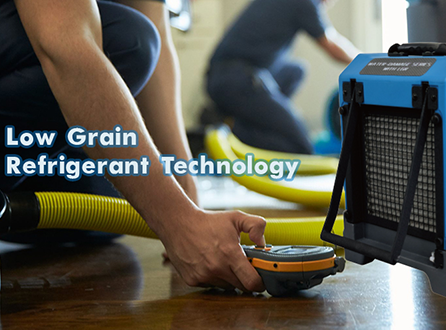
Preair provides professional LGR dehumidifiers for sale. The LGR dehumidifier is well-known for its exceptional dehumidification ability, even in low-humidity environments, which is particularly beneficial for a water-damaged house. The low grain refrigerant dehumidifier can save the soaked furniture, floor, and walls. Due to its high performance, it is also more expensive than ordinary household dehumidifiers. If the budget allows, this type of dehumidifier can be chosen.
Remove/stop the source of the water infiltration (leak, burst pipe, drain issue). A dehumidifier alone won't fix an ongoing leak.
Extract/soak up standing water immediately (shop-vac, sump pump, towels) before relying solely on a dehumidifier.
Place the dehumidifier in the area with the worst saturation, elevate it slightly so intake isn't blocked, and close off the space (doors/windows) to isolate.
Run fans/air movers in addition to the dehumidifier to circulate air across the wet floor so evaporation is possible.
Keep the dehumidifier running constantly until RH in the room drops to ~30-50% and structural materials (wood, subfloor) reach safe moisture levels.
Monitor for mold, warping, or lingering damp smell — if these persist, you may need professional drying or even removal of flooring.
If a basement or unheated space, consider temperature — if too cold, many dehumidifiers lose efficiency.