R&D team continuously improves dehumidification technology

Obtained dozens of dehumidification patents

Quickly respond to customer needs

Care for employees, serve customers, and give back to society

Views: 17 Author: Site Editor Publish Time: 2026-08-25 Origin: Site

Ceiling condensation is a common winter problem, especially in homes, garages, attics, bathrooms, kitchens, and other areas with high indoor humidity. You may notice water droplets, damp spots, peeling paint, or even mold appearing on the ceiling when outdoor temperatures fall.
The good news is that ceiling condensation can usually be reduced by controlling indoor humidity, improving insulation, increasing ventilation, and eliminating cold surfaces.
Condensation occurs when warm, moisture-filled indoor air contacts a surface that is cold enough for the air to reach its dew point.
In winter, the temperature difference between indoor air and the roof or ceiling structure can become significant. If the ceiling surface is poorly insulated or contains thermal bridges, it may become cold enough for water vapor to condense.
Common causes include:
High indoor relative humidity
Poor ceiling or attic insulation
Inadequate attic ventilation
Thermal bridging
Bathroom and kitchen moisture
Drying clothes indoors
Air leakage through the ceiling
Poorly insulated ductwork or pipes
Roof problems or water infiltration
It is important to distinguish condensation from a roof leak. Condensation often appears when temperatures are low and humidity is high, while a roof leak may produce water during or after rainfall.
Controlling indoor relative humidity is one of the most effective ways to reduce condensation.
During winter, a reasonable indoor RH target is often around 30%–50%, although the ideal level depends on outdoor temperature, building construction, insulation, and the temperature of interior surfaces.
If windows and ceilings frequently develop condensation, indoor humidity may be too high for the building's thermal conditions.
A digital hygrometer can help you monitor RH and determine whether humidity is contributing to the problem.
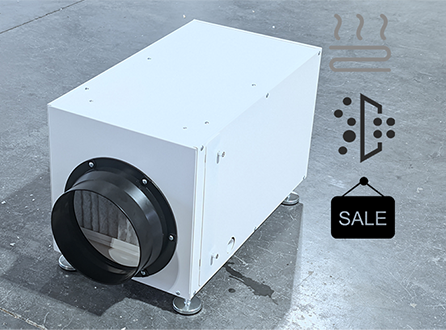
A whole home dehumidifier removes excess water vapor from indoor air and can be particularly useful when ventilation alone cannot keep humidity under control.
For a basement, whole-house, or large living area, choose a dehumidifier with sufficient moisture-removal capacity for the space.
A home dehumidifier can help reduce:
Ceiling condensation
Window condensation
Musty odors
Mold and mildew risk
Excess moisture in enclosed areas
For large buildings or severe moisture problems, a commercial or whole-house dehumidification system may provide more consistent humidity control than a small portable unit.
However, if condensation is caused primarily by a cold, poorly insulated ceiling, dehumidification should be combined with insulation improvements rather than treated as the only solution.
Insulation helps keep the interior ceiling surface warmer.
When the ceiling remains warmer, it is less likely to fall below the dew point of the indoor air. This reduces the chance of condensation.
Check for:
Insufficient insulation thickness
Gaps in insulation
Compressed insulation
Damaged insulation
Uninsulated areas around attic access panels
Thermal bridges around structural components
Proper insulation installation is especially important in cold climates.
If you have an attic above the affected ceiling, proper attic ventilation can help manage heat and moisture.
Depending on the roof design, ventilation may involve soffit vents, ridge vents, gable vents, or other appropriately designed systems.
However, attic ventilation should not be used as a substitute for air sealing. Warm, humid indoor air leaking into the attic can carry significant moisture with it.
Small openings around electrical fixtures, recessed lights, pipes, ducts, attic hatches, and other penetrations can allow warm indoor air to enter cold ceiling or attic spaces.
Air sealing these pathways can reduce moisture transfer and improve energy efficiency.
Pay particular attention to:
Attic access doors
Electrical penetrations
Plumbing penetrations
HVAC ducts
Recessed lighting
Ceiling fixtures
Gaps around chimneys and vents
For safety, electrical and fire-related penetrations should be sealed using materials appropriate for the application.
Bathrooms and kitchens can generate large amounts of water vapor.
Use exhaust fans during and after:
Showers
Baths
Cooking
Boiling water
Dishwashing
Bathroom exhaust fans should discharge outdoors rather than simply moving moist air into an attic or ceiling cavity.
If indoor air remains humid despite normal ventilation, mechanical dehumidification may be necessary.
Increasing indoor temperature can raise the temperature of ceiling surfaces and reduce the likelihood of reaching the dew point.
However, simply increasing the thermostat is not a complete solution. If indoor RH is very high, warm air can still carry substantial moisture.
The more effective strategy is to combine:
Adequate heating + insulation + air sealing + humidity control
Poorly circulated air can create localized cold spots where condensation develops.
Ceiling fans, HVAC air circulation, and appropriate air movement can help distribute heat more evenly throughout a room.
Avoid placing large furniture or other objects in ways that completely block airflow around cold exterior walls and ceilings.
Yes. Persistent condensation can create a damp environment that encourages mold growth.
If you see black, green, or otherwise suspicious growth on a ceiling, don't simply paint over it. First, identify and correct the moisture source.
A successful long-term solution requires controlling the conditions that caused the moisture problem in the first place.
Not every wet ceiling is caused by condensation.
Condensation is more likely when:
It occurs during cold weather.
It appears on cold ceiling areas or corners.
Indoor RH is high.
Several rooms experience similar moisture problems.
Water droplets form on cold surfaces.
A roof leak is more likely when:
Water appears after rain or snow.
There is localized staining.
Water enters around roof penetrations.
The affected area is concentrated below a damaged roof section.
Moisture persists regardless of indoor humidity.
If you cannot identify the source, inspect both the interior and exterior of the roof system.
A whole house dehumidifier is particularly useful when indoor RH remains elevated despite reasonable ventilation and heating.
It can be used in:
Basements
Bathrooms
Garages
Attics where appropriate
Whole-house applications
Commercial buildings
High-humidity storage areas
Set the humidistat to maintain an appropriate RH rather than running the machine continuously without monitoring conditions.
To stop ceiling condensation in winter, focus on controlling both sides of the problem: moisture in the air and cold ceiling surfaces.
Start by measuring indoor RH and checking for obvious moisture sources. Then improve ventilation, use a dehumidifier when necessary, seal air leaks, upgrade insulation, and ensure the attic is properly designed and ventilated.
If condensation continues after humidity has been controlled, investigate insulation defects, thermal bridges, roof problems, or hidden moisture intrusion.
The most effective long-term solution is not simply to wipe away the water—it is to prevent the ceiling surface from reaching the dew point in the first place.