
R&D team continuously improves dehumidification technology

Obtained dozens of dehumidification patents

Quickly respond to customer needs

Care for employees, serve customers, and give back to society

Views: 1 Author: Site Editor Publish Time: 2026-11-20 Origin: Site


Sizing a crawl space dehumidifier is the single most critical decision in crawl space encapsulation and moisture management. Choose a unit that is too small, and persistent relative humidity above 60% will trigger wood rot, attract subterranean termites, and foster hazardous mold colonies. Choose a unit that is improperly configured, and you will suffer from high electricity bills and short-cycling equipment.
For a typical encapsulated crawl space with a continuous vapor barrier, you need approximately 50 to 70 pints per day (PPD at AHAM standard) for areas up to 1,000 sq. ft., 70 to 95 PPD for 1,000 to 2,000 sq. ft., and 110 to 155+ PPD for large crawl spaces between 2,000 and 3,500+ sq. ft. If your crawl space is unsealed, vented, has an exposed dirt floor, or sits in a high-water-table region, you must increase capacity by 30% to 50% to counteract constant ground evaporation and outdoor vapor drive.
The table below provides baseline capacity recommendations based on the AHAM testing standard (80℉ / 60%RH), assuming a standard crawl space height of 3 to 4 feet.
Crawl Space Area (Sq. Ft.) | Approximate Volume (Cu. Ft.) | Encapsulated (Sealed Liner & Vents) | Moderately Damp (Partial Liner / Minor Infiltration) | Severe Moisture / Unsealed Vents |
Up to 800 sq. ft. | 2,400 – 3,200 cu. ft. | 50 – 55 PPD | 60 – 70 PPD | 70 – 85 PPD |
800 – 1,500 sq. ft. | 3,200 – 6,000 cu. ft. | 70 – 85 PPD | 85 – 100 PPD | 105 – 120 PPD |
1,500 – 2,200 sq. ft. | 6,000 – 8,800 cu. ft. | 90 – 105 PPD | 110 – 125 PPD | 130 – 150 PPD |
2,200 – 3,200 sq. ft. | 8,800 – 12,800 cu. ft. | 110 – 130 PPD | 135 – 155 PPD | Dual 80–90 PPD Units |
3,200+ sq. ft. | 12,800+ cu. ft. | 140 – 160+ PPD | Dual 90–110 PPD Units | Dual 110–130 PPD Units |
When shopping for dehumidifiers in North America, capacity is designated in pints per day (PPD)—the volume of water extracted from ambient air over a 24-hour continuous operating cycle. However, understanding how manufacturers rate these pints is essential to avoid purchasing an undersized unit.
Crawl space dehumidifiers publish two distinct extraction ratings:
AHAM Rating (80℉ / 60%RH):
Established by the Association of Home Appliance Manufacturers, this is the realistic benchmark rating for North American conditions. A 90-pint AHAM unit removes 90 pints (approx. 11.25 gallons) of water per day under standard testing conditions.
Saturation / Maximum Rating (90℉ / 90%RH):
This represents performance in a tropical greenhouse. A dehumidifier marketed as "180 Pints Maximum" might only pull 80 to 90 pints under AHAM conditions and less than 50 pints in a cold crawl space.
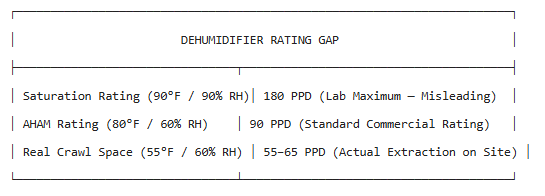
Crawl spaces are subterranean environments where ground temperatures keep air between 50℉and 65 ℉ (10-18℃) for most of the year. Because colder air holds significantly less moisture vapor than warm air, a unit rated at 100 PPD in a warm lab will extract roughly 60 to 70 pints per day in a cool 55℉ crawl space.
Always size your equipment using AHAM ratings, and select units with active hot-gas bypass defrost so the machine does not spend half its operating cycle frozen in cold ground temperatures.
Professional HVAC and crawl space remediation contractors calculate required capacity using cubic air volume and Air Changes per Hour (ACH) targets.
Multiply your crawl space length, width, and average ceiling height (ground to bottom of floor joists):
Cubic Feet = Length (ft) x Width (ft) x Height (ft)
Example: A home with a 40ft * 50ft foundation footprint and an average height of 3.5ft has a volume of: 40 *50 * 3.5 = 7,000 cu.ft.
To keep moisture from stagnating in dead zones and under plumbing drops, air must cycle through the dehumidifier 3 to 4 times per hour (3–4 ACH) in a sealed space, or 5 to 6 ACH in an unsealed or damp space:
Required airflow (CFM) = (Cubic Footage * Desired ACH) / 60 minutes
For our 7,000 cu. ft. space at 3 ACH: CFM = 7000*3/60=350 CFM
Step 3: Match CFM with AHAM Pints Per Day (PPD)
Select an under-house dehumidifier for crawl space whose internal blower provides adequate CFM (typically 200–400 CFM for units ranging from 70 to 120 PPD). A high-airflow blower ensures dry air is distributed across the entire footprint rather than short-cycling air around the unit intake.
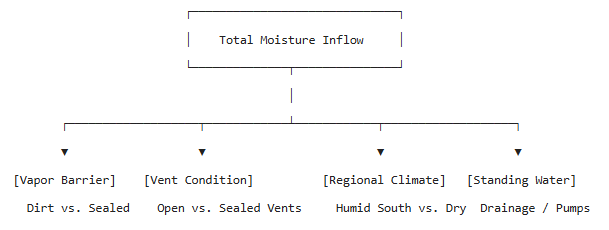
Square footage is only the baseline. Four structural and climatic variables dictate whether you need a standard unit or a high-capacity commercial machine.
Open Vented Crawl Spaces:
In summer, warm outside air (e.g., 90°F, 75% RH) enters foundation vents and hits the cool 60°F subfloor, causing relative humidity to spike to 90%–100% (condensation/sweating pipes). A vented crawl space requires
40%–60% more pint capacity
and will constantly fight infinite outdoor humidity.
Encapsulated Crawl Spaces:
Sealed foundation vents, insulated perimeter walls, and foam-sealed penetrations isolate the space. Moisture load drops dramatically, allowing a smaller, energy-efficient central air dehumidifier to maintain 45%–50% RH effortlessly.
Exposed soil continuously releases gallons of water vapor into the air through capillary action and evaporation.
Bare Dirt Floor:
Generates up to
10–12 gallons (80–96 pints)
of ground moisture daily per 1,000 sq. ft.
Thin 6-mil Clear Polyethylene (Unsealed Seams):
Slows evaporation by 60%, but punctures easily and allows edge migration.
Heavy-Duty 12-mil to 20-mil Reinforced Crawl Space Liner (Taped & Sealed to Piers):
Reduces ground vapor migration by over 98%, allowing you to downsize your dehumidifier capacity while ensuring permanent dry conditions.
Homes in the US Southeast (Florida, Georgia, Carolinas, Alabama, Gulf Coast) and Mid-Atlantic face extreme outdoor dew points exceeding 75°F from May to October. Air infiltration through foundation cracks carries heavy moisture loads, requiring a minimum 90 to 110 PPD unit even for moderate 1,500 sq. ft. homes. In drier Western climates, a 55 to 70 PPD unit is typically sufficient for the same footprint.
A dehumidifier is designed to remove airborne water vapor, not dry up standing pools of liquid water. If downspout runoff or high water tables cause puddle accumulation in your crawl space, you must install an interior French drain and a submersible sump pump system before relying on a dehumidifier. Running a dehumidifier over standing water will burn out the compressor within months.
Here is how to match specific residential crawl space floor plans to commercial dehumidifier capacity.
Recommended Capacity:
50 to 70 PPD (AHAM)
Ideal Airflow:
150 – 220 CFM
Target Applications:
Small single-story ranch homes, manufactured homes, residential additions, and tight crawl spaces with ceiling heights under 30 inches.
Key Unit Attributes:
Low-profile horizontal chassis (under 14 inches high), lightweight design for crawl hole access, and quiet operation (<50 dBA).
Recommended Capacity:
70 to 95 PPD (AHAM)
Ideal Airflow:
200 – 300 CFM
Target Applications:
Standard suburban 3-bedroom to 4-bedroom single-family residences, split-level foundations, and encapsulated spaces with mild plumbing condensation.
Key Unit Attributes:
Integrated automatic condensate purge pump with 15–20 ft. vertical lift, digital humidistat, and optional supply duct collar for multi-room air distribution.
Recommended Capacity:
110 to 155+ PPD (AHAM)
or
Dual Distributed Units
Ideal Airflow:
350 – 450+ CFM
Target Applications:
Large custom homes, commercial buildings, sprawling foundations with interior dividing foundation walls, or homes with heavy ductwork obstructions.
When a foundation exceeds 2,800 sq. ft. or features masonry dividing walls that restrict natural airflow, installing
two 70–80 PPD units placed at opposite ends
provides superior moisture control compared to a single 150 PPD unit in a central location.
Proper capacity selection protects your investment, your building's structural integrity, and your energy bill.
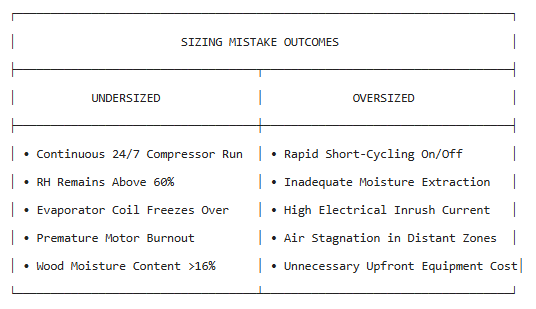
Installing a cheap residential 35-pint basement dehumidifier in a damp crawl space is a recipe for failure:
Never Reaches Target RH:
The unit runs continuously 24 hours a day without dropping humidity below the 60% mold threshold.
Elevated Wood Moisture Content (WMC):
Framing lumber absorbs airborne moisture. When WMC exceeds 16%–19%, wood-decay fungi and termites thrive.
Coil Icing & Burnout:
Undersized units run their refrigeration circuits non-stop in cold crawl air, freezing coils into solid ice blocks and burning out compressor capacitors within one to two seasons.
While slight oversizing (15%–20% safety margin) is beneficial, severe oversizing causes short-cycling:
Rapid Temperature Swings Without Dehumidification:
1). An oversized machine pulls high airflow over its coils and satisfies the humidistat sensor within 5 minutes, shutting off before moisture has condensed out of framing timber.
Electrical Surges:
2). Compressors draw 3x to 5x their running amperage during startup (inrush current). Short-cycling 10 times an hour spikes electricity bills and strains household electrical breakers.
Pint capacity is meaningless if the unit cannot survive the harsh environmental conditions of a crawl space. When selecting a commercial-grade unit (such as those engineered by Hangzhou Hongtai / Preair), prioritize these four engineering features:
Ensures continuous water extraction without prolonged passive shutdown cycles.
Protects internal heat exchangers and evaporator coils from airborne dirt, crawl space dust, and insulation fibers, maintaining thermal transfer efficiency for 10+ years.
Eliminates the need to crawl under the house to adjust setpoints or inspect error codes. Digital wall-mount controls in your living room or smartphone monitoring alert you immediately if humidity spikes.
Set your crawl space humidistat between 45% and 50% Relative Humidity (RH). Setting it higher than 55% risks mold germination and wood rot, while setting it below 40% causes unnecessary electricity consumption and can cause subfloor hardwood shrinkage.
No. Standard basement dehumidifiers are designed for heated, conditioned rooms above 65°F with bucket drainage. In an unconditioned crawl space, standard units freeze up below 60°F, lack automated high-lift condensate pumps, have fragile plastic housings, and fail within 12 to 18 months under continuous moisture loads.
Since 1 gallon equals 8 pints, a 70-pint unit removes approx. 8.75 gallons, a 90-pint unit removes 11.25 gallons, and a 120-pint commercial unit removes 15 gallons of liquid water every 24 hours under peak load conditions.
An Energy Star-certified commercial crawl space dehumidifier (rated at 5.5 to 7.0 Amps, 550–700 Watts) running an average of 8 to 12 hours daily consumes approximately 150 to 250 kWh per month. At an average US electricity rate of $0.15/kWh, operational costs average $22 to $38 per month.
During the initial 1 to 2 weeks following installation or encapsulation, the unit will run continuously (24/7) to extract deep moisture trapped in wood floor joists, subfloors, and concrete masonry. Once the structural Wood Moisture Content (WMC) drops below 12%–14%, the unit will cycle on and off automatically, running 6 to 10 hours per day to maintain a steady 50% RH.
Looking for high-efficiency, commercial-grade crawl space dehumidifiers or OEM/ODM manufacturing solutions? Discover rugged, low-profile, high-capacity humidity control systems at Hangzhou Hongtai Electrical Co., Ltd. (hzhongtai.com).


