


R&D team continuously improves dehumidification technology

Obtained dozens of dehumidification patents

Quickly respond to customer needs

Care for employees, serve customers, and give back to society

Views: 1 Author: Site Editor Publish Time: 2026-08-11 Origin: Site
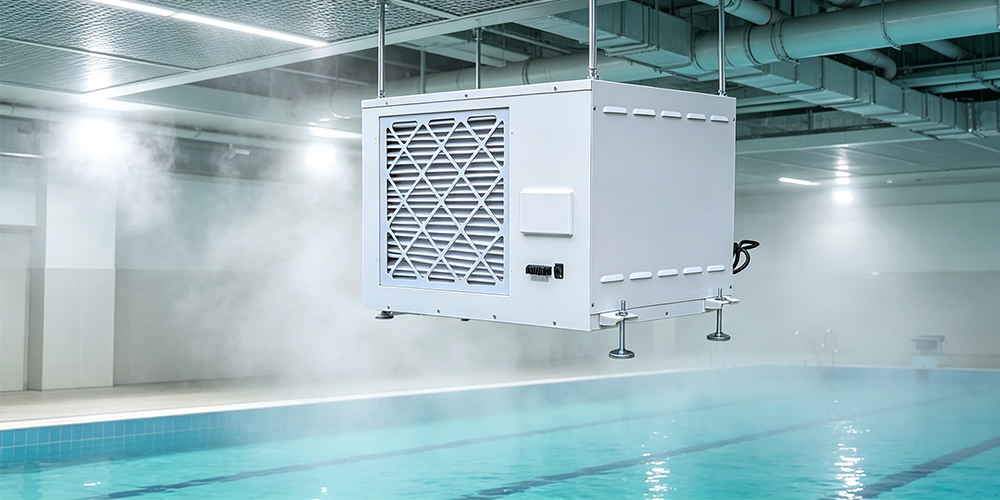
Aquatic centres, indoor swimming pools, natatoriums, and leisure pools have one thing in common: large amounts of water are constantly being introduced into the indoor environment. Warm pool water evaporates into the air, increasing indoor humidity. Without effective humidity control, condensation can form on windows, ceilings, walls, and metal structures, potentially causing corrosion, mold growth, structural damage, and poor indoor comfort.
This is why aquatic centre dehumidifiers are an essential part of many indoor pool HVAC systems.
Indoor swimming pools generate much more moisture than typical commercial buildings. Water continuously evaporates from pool surfaces, SPA pools, hot tubs, showers, wet floors, splash areas, changing rooms, and water features. The warmer the pool water and the surrounding air, the greater the potential for evaporation. If this moisture is not removed, relative humidity can rise significantly. When humid air contacts a surface that is colder than the air's dew point, water vapor can condense into liquid water.
Extra moisture can lead to condensation on windows and skylights, corrosion of metal structures, deterioration of ceilings and walls, mold and mildew growth, damage to insulation, unpleasant odors, slippery surfaces, poor thermal comfort, and increased building maintenance costs.
An aquatic centre dehumidifier helps continuously remove moisture from the air and maintain a controlled indoor environment.
Most aquatic centre dehumidifiers use a refrigeration-based dehumidification process. The basic process is:
Humid air → cooling coil → condensation → water drainage → reheated dry air → return to pool room
A fan draws warm, moisture-laden air from the pool hall into the dehumidifier. Because indoor pool air can contain a large amount of water vapor, the airflow rate and moisture-removal capacity of the system must be carefully matched to the pool environment.
Inside the dehumidifier, the humid air passes over a cold evaporator coil. The coil temperature is maintained below the air's dew point. As the air cools, its ability to hold water vapor decreases. The excess water vapor therefore changes from a gas into liquid water. This is the condensation process.
The condensed water collects on the evaporator coil and flows into a drain pan. From there, it is discharged through a drainage system. Unlike ventilation alone, a dehumidifier actually removes water from the indoor air. This is particularly important in humid climates where bringing large amounts of outdoor air into an indoor pool may introduce even more moisture.
After moisture has been removed, the air is typically reheated before being returned to the aquatic centre. This is an important characteristic of refrigeration dehumidification. A dehumidifier does not simply cool the air. The refrigeration cycle can recover heat and return relatively warm, dry air to the pool hall. This helps maintain the desired indoor temperature while controlling humidity.
The dehumidified air is then distributed throughout the aquatic centre. The system continues to repeat this cycle: humid air in → moisture removed → dry air out.
With appropriate controls, the system can automatically adjust operation according to indoor humidity and temperature conditions.
The dew point is particularly important in indoor swimming pool design. When a surface temperature falls below the dew point of the surrounding air, condensation can occur. For example, if warm, humid air comes into contact with a cold window, the glass may become covered with water droplets. This is why simply measuring relative humidity is not always enough when designing humidity control for an aquatic centre.
Engineers also need to consider:
Indoor air temperature
Relative humidity
Dew-point temperature
Surface temperatures
Outdoor temperature
Pool-water temperature
Building envelope characteristics
Maintaining appropriate humidity helps reduce the risk that indoor surfaces will fall below the air's dew point.
A residential dehumidifier and an aquatic centre dehumidification system may use the same basic refrigeration principle, but their applications are very different.
Feature | Residential Dehumidifier | Aquatic Centre Dehumidifier |
Typical moisture load | Low to moderate | Very high |
Operating environment | Homes | Large humid pool halls |
Airflow | Relatively low | High |
Capacity | Small to medium | Commercial/industrial |
Controls | Basic humidity control | Advanced HVAC integration |
Corrosion resistance | Standard | Often enhanced |
Installation | Portable or residential | Ducted, wall-mounted, or centralized |
Continuous operation | Limited/moderate | Designed for demanding operation |
Heat recovery | Usually limited | Often incorporated |
Fresh-air integration | Optional | Common in larger systems |
An aquatic centre requires equipment specifically designed for high moisture loads, continuous operation, corrosion risks, and large air volumes.
There is no single configuration suitable for every pool facility.
Packaged dehumidifiers are self-contained systems that can be installed within or near the pool area. They are suitable for smaller or medium-sized facilities where a dedicated dehumidification unit is required.
Ducted systems connect the dehumidifier to an air-distribution network. They can provide more uniform air distribution and allow engineers to control airflow throughout a large pool hall.
Ducted systems are commonly considered for large swimming pools, aquatic centres, sports facilities, hotels, resorts, and recreation centres.
Large aquatic facilities may integrate dehumidification with a complete air-handling system.
Such systems can combine dehumidification, heating, cooling, ventilation, heat recovery, outdoor-air control, air filtration, and humidity monitoring.
This approach provides more comprehensive environmental control.
A major advantage of many commercial pool dehumidification systems is heat recovery. When the refrigeration cycle removes moisture from the air, it also generates heat. Instead of simply rejecting this heat outdoors, an aquatic-centre dehumidifier can use it to help heat pool hall air, outdoor ventilation air, pool water, and other areas of the facility. This can reduce the energy required from separate heating equipment.
For facilities that operate year-round, heat recovery can therefore be an important part of overall energy management.
Condensation control is one of the primary objectives of pool-room dehumidification. The system monitors indoor conditions and removes sufficient moisture to keep the air's dew point at an appropriate level. Air distribution also matters. Dry air should be strategically delivered toward areas that are vulnerable to condensation, such as exterior windows, skylights, exterior walls, structural steel, and roof structures.
Proper air movement can help maintain warmer surface temperatures and reduce localized condensation. Therefore, dehumidification and air distribution need to work together.
Outdoor ventilation can remove moisture from an indoor pool, but its effectiveness depends heavily on outdoor conditions. In a dry climate, ventilation may provide useful moisture removal.
However, in a hot and humid climate, outdoor air can contain a substantial amount of water vapor. Bringing large quantities of outdoor air into the pool hall may actually increase the moisture load. An industrial dehumidification system allows the facility to remove moisture mechanically while maintaining greater control over indoor conditions.
The best system may therefore combine:
Dehumidification + controlled ventilation + heating/cooling + air circulation
rather than relying on ventilation alone.
Many indoor pool environments are designed around a relative humidity range of approximately 50%–60% RH, although the appropriate target depends on the facility's design, pool temperature, building materials, comfort requirements, and local climate. The objective is not simply to achieve the lowest possible humidity. Excessively low humidity can increase evaporation from the pool and may create unnecessary energy consumption.
The goal is to find a balance between:
Human comfort
Condensation prevention
Pool-water evaporation
Building protection
Energy efficiency
A properly designed dehumidification system can provide several benefits.
Humidity control reduces condensation and helps protect walls, ceilings, insulation, windows, and structural components.
Chlorinated pool environments can be particularly aggressive toward metal components. Controlling moisture can help reduce corrosion-related problems.
Stable temperature and humidity make the pool environment more comfortable for swimmers, staff, and spectators.
Maintaining appropriate humidity reduces conditions that support mold and mildew growth.
Preventing condensation and moisture accumulation can reduce building repairs and maintenance requirements.
Modern systems can incorporate heat recovery and intelligent controls to reduce unnecessary heating and ventilation loads.
Modern commercial dehumidifiers can incorporate digital controls and sensors to continuously monitor indoor conditions.
Depending on the system, controls may include:
Relative humidity sensors
Temperature sensors
Dew-point monitoring
Automatic humidity setpoints
Variable-speed fans
Compressor control
Outdoor-air control
Heat-recovery control
Alarm functions
Remote monitoring
Building management system integration
These features allow the system to respond dynamically to changing conditions.
Aquatic centre dehumidifiers work by removing water vapor from humid indoor air and controlling the temperature and humidity of the pool environment. Refrigeration-based systems cool humid air below its dew point, condense the excess moisture, drain the collected water, and return dry air to the building.
For larger facilities, dehumidification can be integrated with ventilation, heating, cooling, heat recovery, and building management systems.
For any indoor swimming pool or aquatic centre, the right dehumidification strategy should be based on the facility's pool size, water temperature, indoor conditions, climate, occupancy, ventilation requirements, and overall HVAC design.


