R&D team continuously improves dehumidification technology

Obtained dozens of dehumidification patents

Quickly respond to customer needs

Care for employees, serve customers, and give back to society

Views: 21 Author: Site Editor Publish Time: 2026-03-31 Origin: Site


Condensation in a warehouse is a psychrometric problem—it occurs when warm, moisture-laden air contacts a surface below its dew point temperature. Fixing it requires controlling either air moisture content, surface temperature, or airflow patterns.
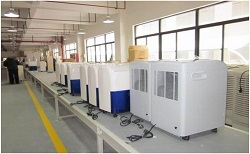
The most reliable solution is installing a properly sized industrial dehumidifier.
Why it works:
Lowering the dew point prevents moisture from reaching saturation.
Stabilizes RH across the entire volume.
Target:
Maintain 40–55% RH (depending on goods stored)
Key sizing factor:
Warehouse volume (cubic feet)
Moisture load (infiltration, processes, weather)
Poor airflow creates microclimates where condensation forms.
Strategy:
Install HVLS (high-volume, low-speed) fans
Keep air moving across:
Exterior walls
Ceilings
Corners and shelving zones
This prevents localized cold spots and equalizes temperature and humidity.
Condensation often forms on:
Metal structures
Roof panels
Uninsulated walls
Solutions:
Add thermal insulation (spray foam, fiberglass panels)
Install vapor barriers
Use anti-condensation coatings
Goal: Keep surface temperature above dew point
Uncontrolled air infiltration introduces humid outside air.
Check:
Loading dock doors
Roof gaps
Wall penetrations
Windows and joints
Fix:
Weather stripping
Dock seals
Air curtains
Condensation spikes when:
Warm, humid air enters a cooler warehouse
Day/night temperature swings occur
Options:
Slightly increase indoor temperature (raises surface temps)
Use destratification fans to reduce ceiling-floor gradients
Ventilation only works when outside air is drier than inside.
In humid climates, ventilation can worsen condensation.
In dry climates, it can help reduce moisture load.
Focus on:
Ceilings (dripping risk)
Skylights
Metal beams
Stored goods near exterior walls
Use:
Drip trays
Localized airflow
Spot dehumidification
Relative humidity alone is misleading. Track dew point
Why:
Condensation occurs when the surface temperature is less than the dew point
Gives you predictive control instead of reactive fixes
Sudden weather change (humid air influx)
Poor insulation → cold surfaces
Oversized ventilation brings in moist air
No humidity control system
Scenario:
A 50,000 sq ft warehouse with metal roofing is experiencing ceiling drips.
Fix stack:
Install an industrial dehumidifier for warehouse (primary control)
Add roof insulation + vapor barrier
Seal dock doors
Add commercial air movers for airflow
Result: condensation eliminated, stable RH
Condensation stops when you:
Lower the dew point
Raise surface temperatures
Eliminate stagnant air zones