
R&D team continuously improves dehumidification technology

Obtained dozens of dehumidification patents

Quickly respond to customer needs

Care for employees, serve customers, and give back to society

Views: 0 Author: Site Editor Publish Time: 2026-11-23 Origin: Site


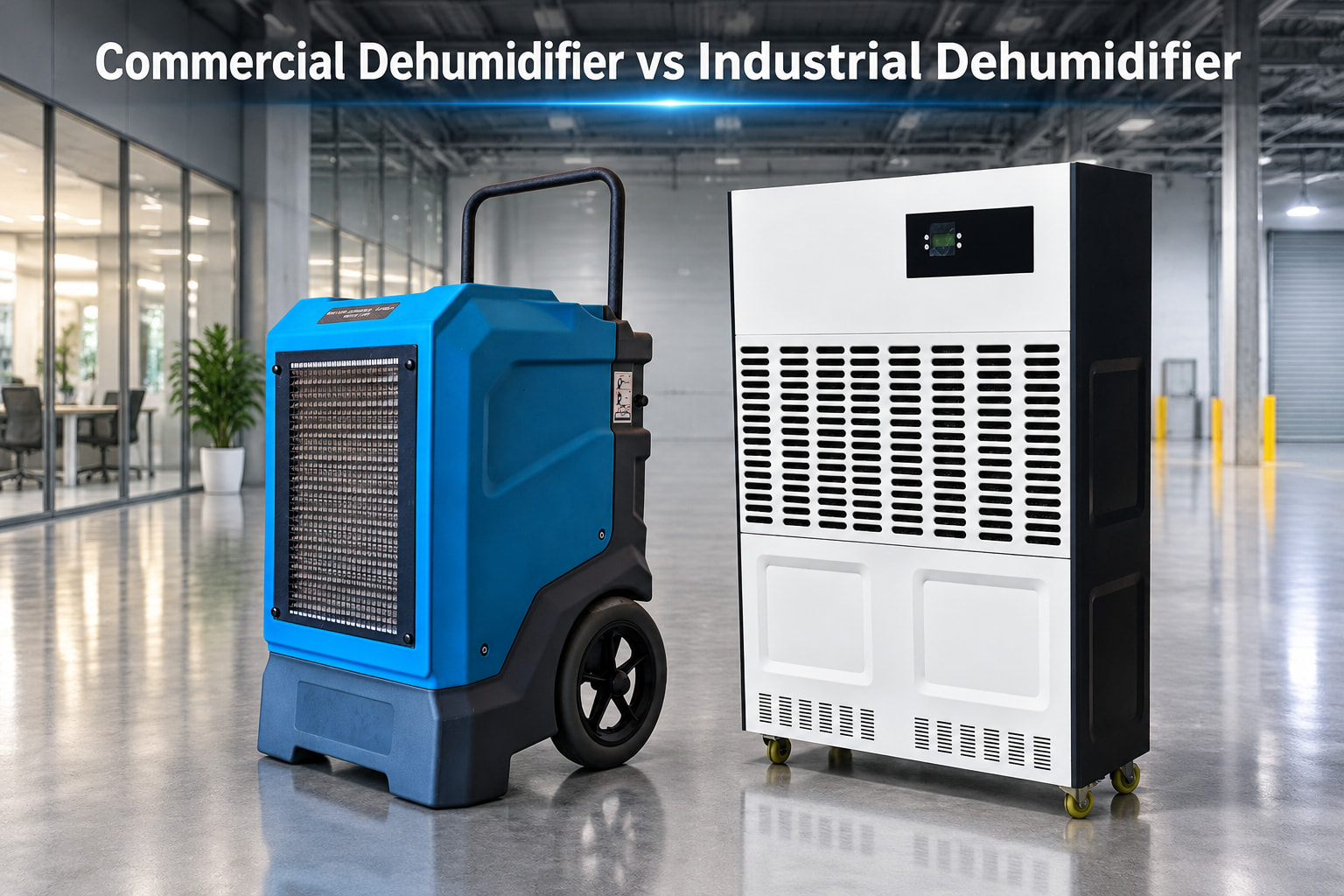
When managing indoor humidity across commercial properties and industrial facilities, selecting the wrong equipment leads to accelerated mold growth, compromised product integrity, corrosion, and massive energy waste. While both systems outperform residential units, commercial dehumidifiers and industrial dehumidifiers are engineered for distinct operating environments, duty cycles, and moisture loads.
Feature / Dimension | Commercial Dehumidifier | Industrial Dehumidifier |
Typical Capacity Range | 60 – 250 Pints/Day (PPD) / 30 – 120 L/Day (at AHAM) | 250 – 1,000+ PPD / 120 – 500+ L/Day (Scalable tonnage) |
Airflow Volume (CFM) | 200 – 600 CFM | 600 – 3,500+ CFM (High External Static Pressure) |
Operating Environments | Basements, gyms, crawl spaces, hotels, retail, grow rooms, water damage restoration | Heavy manufacturing, food processing, chemical storage, large logistics warehouses, cold storage |
Dehumidification Technology | Standard Refrigerant Condensation / Low Grain Refrigerant (LGR) | Heavy-Duty Refrigerant (Scroll/Rotary) / Industrial Desiccant Rotors |
Design & Form Factor | Compact, stackable, rugged roto-molded shell or ceiling-ducted | Heavy-gauge galvanized steel frame, skid-mounted or ceiling-ducted |
Duty Cycle & Redundancy | Intermittent to semi-continuous (Auto-defrost / Humidistat) | Continuous 24/7/365 heavy-duty operation with BMS integration |
Target Relative Humidity | 40% – 60% RH | Sub-40% RH down to ultra-low dew points (<10% RH via Desiccant) |
A commercial dehumidifier is designed to manage humidity in public, light-commercial, and specialized business environments where moisture levels must be controlled to safeguard structural materials, maintain guest comfort, or accelerate drying.
1. Mobility and Ductability: Commercial units often feature roto-molded or powder-coated steel housings, ergonomic handles, semi-pneumatic wheels, and stackable profiles for easy transport across job sites (e.g., water mitigation projects).
2. LGR (Low Grain Refrigerant) Technology: Advanced commercial drying systems utilize LGR technology, which pre-cools the incoming moisture-laden air before it hits the evaporator coils. This enables continuous moisture extraction even at lower relative humidity levels (below 40% RH) and lower temperatures.
3. Flexible Installation: Available in mobile floor models, wall-mounted configurations, and slim ceiling-suspended (ducted) formats that integrate directly into existing HVAC ductwork.
Water Damage Restoration & Flood Recovery: Rapid structural drying of drywall, carpets, and subfloors.
Commercial Greenhouses & CEA (Controlled Environment Agriculture): Regulating transpiration and preventing Botrytis/fungus in indoor cannabis and vegetable canopy zones.
Hospitality & Fitness Centers: Eliminating musty odors and moisture build-up in indoor hotel pools, spas, and locker rooms.
Commercial Basements & Crawl Spaces: Continuous moisture protection against subterranean water ingress.
An industrial dehumidifier is a heavy-duty moisture control system engineered for large-scale production plants, massive distribution centers, and strict process-controlled manufacturing environments.
1. Extreme Moisture Extraction & High Air Volume: Engineered with high-efficiency commercial scroll compressors and heavy-duty centrifugal blowers capable of moving thousands of cubic feet per minute (CFM) against high external static pressure.
2. Corrosion Resistance & Industrial-Grade Housings: Built with epoxy-coated coils, marine-grade stainless steel, or heavy-duty galvanized structural frames to resist aggressive airborne chemicals, high salt content, and acidic or corrosive atmospheres.
3. Advanced Microprocessor & BMS Integration: Equipped with RS485/Modbus communication protocols for full integration into centralized Building Management Systems (BMS), enabling automated multi-zone tracking, continuous data logging, and precise dew-point control.
4. Desiccant vs. Industrial Refrigerant Flexibility: When industrial processes require ultra-low dew points (e.g., lithium battery manufacturing, pharmaceutical cleanrooms, or sub-zero cold storage), industrial desiccant dehumidifiers using silica gel rotors operate efficiently down to -20°C (-4°F).
Food & Beverage Processing: Preventing condensation in meat packing, confectionery sugar coating, and bakery packaging lines.
Logistics & Warehousing: Preventing rust and corrosion on stored steel, automotive parts, and moisture-sensitive packaged goods.
Pharmaceutical & Cleanroom Manufacturing: Maintaining tightly regulated RH levels (30%–45% RH) to preserve powder consistency and prevent bacterial contamination.
Water Treatment Plants & Pumping Stations: Eliminating surface sweat and structural condensation on industrial pipes and valves.
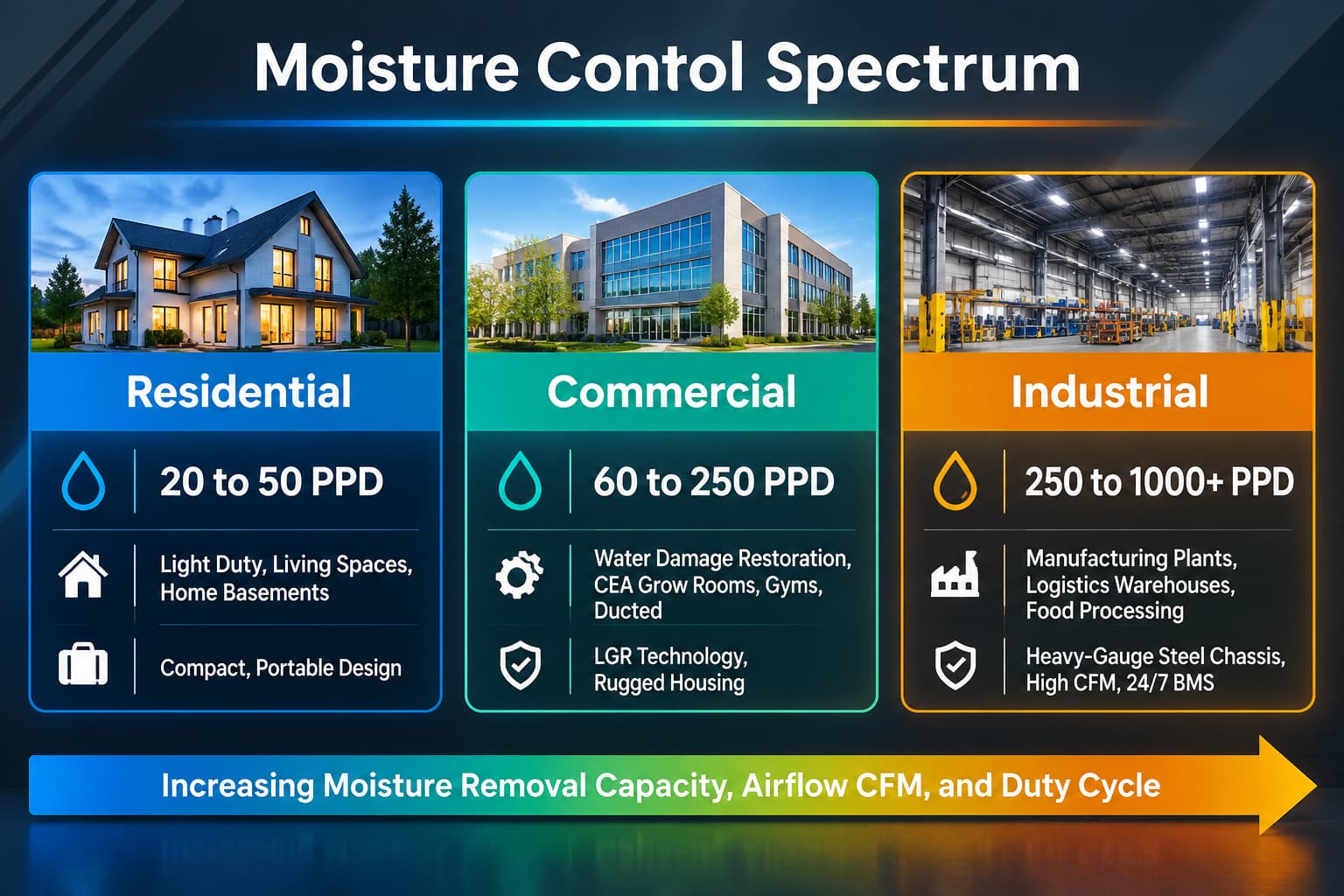
Commercial and industrial units are evaluated under strict engineering test conditions established by AHAM (Association of Home Appliance Manufacturers):
AHAM Conditions: 80℉ (26.7℃) and 60 % RH 60% RH - represents realistic, standardized operating parameters.
Saturation Conditions: 90 ℉ (32.2℃) and 90% RH - maximum moisture extraction capacity.
While high-capacity commercial units typically peak between 120 PPD and 250 PPD (AHAM), industrial-grade systems start at 250 PPD and scale beyond 1,000+ PPD (500+ L/Day) with multi-ton refrigeration circuits.
Commercial units (200 - 600 CFM) are designed for targeted space turnover or localized duct runs (typically < 0.4 w.g. static pressure).
Industrial systems (800 - 3,500+ CFM) feature backward-curved centrifugal fans designed to push air through extensive industrial duct networks with high static resistance (> 1.0 w.g.).
Commercial Dehumidifiers: Often utilize Hot Gas Bypass (HGB) or temperature-controlled electronic defrost to operate in cold basements and restoration sites down to 38-41℉ (3-5℃).
Industrial Dehumidifiers: Industrial refrigerant models handle high-ambient heat loads (104 ℉+ / 40℃+) in industrial plants, while industrial desiccant units manage sub-zero environments down to -4℉ (-20℃).
With global environmental mandates phasing down high-GWP refrigerants (EU F-Gas Regulation and US EPA AIM Act), modern commercial and industrial dehumidifiers are transitioning to low-GWP, energy-efficient A2L refrigerants (such as R32 and R454B), alongside high-performance microchannel heat exchangers that deliver higher coefficient of performance (COP / L/kWh) while reducing energy consumption.
To help procurement officers and project engineers make an informed investment, here is a practical selection matrix highlighting specialized systems manufactured by HONGTAI :
Operational Needs: High mobility, extreme low-grain water extraction, rugged roto-molded shockproof housing, built-in condensate pump.
Recommended System: HONGTAI ALGR65L / 110L LGR Commercial Dehumidifier
Features high-COP, low-grain refrigeration, heavy-duty wheels, compact stackability, and automated condensate purge pumps for 24/7 unattended drying.
Operational Needs: Precise VPD (Vapor Pressure Deficit) management, continuous canopy moisture extraction, microbial defense.
Recommended System: HONGTAI PRO300 Commercial Grow Room Dehumidifier
Engineered for wall-mounted or freestanding grow facility layouts, delivering high-volume moisture removal with onboard digital humidistats to protect high-value crops from mold.
Operational Needs: Concealed ceiling installation, zero floor footprint, low acoustic noise, direct ducted airflow integration.
Recommended System: HONGTAI Guard120 Commercial Ceiling-Mounted Dehumidifier
Ultra-slim ducted design equipped with high-static pressure blowers, industrial-grade filtration, and smart remote panel controls.
Operational Needs: Heavy-duty continuous 24/7 moisture extraction, high CFM air distribution, robust steel chassis, wide-area coverage.
Recommended System: HONGTAI CFZ10 / CFZ20 Industrial Refrigerant Dehumidifiers
Featuring industrial-grade scroll compressors, epoxy anti-corrosion evaporator coils, and microcomputer-automated humidity control tailored for manufacturing and logistics facilities.
Before submitting an RFP or purchasing equipment, use this step-by-step formula to estimate your baseline moisture load:
PPD Required = (Volume of Space * Target Air Changes per Hour * Delta Grains per lb) / (7,000 grains/lb * 24hours)
1. Calculate Space Volume: Length * Width * Height (ft).
2. Determine Infiltration & Load Sources: Account for outdoor air ventilation, building envelope leakage, occupant count (approx. 0.1lb/hr per person), and internal open water surfaces or plant transpiration rates.
3. Select Equipment Class:
If total moisture load is under 250 PPD and requires zoned or flexible placement - Commercial Dehumidifier.
If total moisture load exceeds 300 - 1,000+ PPD with heavy continuous heat/moisture generation - Industrial Dehumidifier (CFZ Series or Central Ducted Industrial Array).
Answer: Yes, in segmented layouts or facilities with multiple micro-climates (such as multi-tier indoor agriculture or compartmentalized storage rooms), deploying several distributed commercial units (e.g., PRO300 or ALGR series) provides built-in redundancy and uniform air mixing. However, for massive open-span warehouses or high-ceiling factories, a centralized industrial dehumidifier (such as the CFZ20) is significantly more cost-effective in terms of ducting simplicity, installation labor, and electrical infrastructure.
Answer: AHAM capacity is tested at 80℉ (26.7℃) and 60% RH, which mirrors real-world commercial interior environments. Saturation capacity is measured at 90℉(32.2℃) and 90%RH. When comparing equipment specifications and calculating sizing, always base your engineering calculations on AHAM capacity to prevent undersizing your humidity control system.
Answer: LGR dehumidifiers employ an internal heat pipe or air-to-air heat exchanger to pre-cool incoming humid air before it touches the primary evaporator coil. This lowers the temperature of the air closer to its dew point, allowing the unit to continue extracting water even when the ambient humidity drops below 40%RH (where standard refrigeration systems lose efficiency).
Answer: Yes. HONGTAI is an ISO-certified OEM/ODM dehumidifier manufacturer with extensive manufacturing and testing facilities. Customizations include custom PPD capacities, A2L refrigerant configurations, private-label powder coating/housings, dual-voltage power supplies 110V/60Hz, 220V/50Hz, 460V/3Ph, integrated IoT/BMS connectivity, and compliance with ETL, CE, UL, and Energy Star standards.
Choosing between a commercial and industrial dehumidifier comes down to your facility's square footage, continuous moisture load, target relative humidity, and physical installation requirements:
Choose Commercial Dehumidifiers for water restoration projects, commercial indoor cultivation, gyms, crawl spaces, and light commercial ducted installations.
Choose Industrial Dehumidifiers for manufacturing facilities, food/pharmaceutical processing plants, expansive logistics warehouses, and heavy-duty 24/7 continuous operations.
Looking for reliable, energy-efficient moisture control systems or custom private-label solutions?
Explore the full range of commercial and industrial dehumidifiers at hzhongtai.com or contact our engineering team today for technical sizing consultations and OEM/ODM factory-direct quotations.


