
R&D team continuously improves dehumidification technology

Obtained dozens of dehumidification patents

Quickly respond to customer needs

Care for employees, serve customers, and give back to society

Views: 0 Author: Site Editor Publish Time: 2026-11-23 Origin: Site


In commercial indoor cultivation and Controlled Environment Agriculture (CEA), precision moisture management directly determines crop yield, cannabinoid and terpene potency, microbial compliance, and energy expenditure. An undersized dehumidification system leads to devastating crop loss from Botrytis cinerea (bud rot) and powdery mildew, while an oversized, poorly staged system leads to short-cycling, localized microclimates, and excessive operating expenses (OPEX).
The fundamental rule of grow room moisture load engineering:
Daily Moisture Load (Pints/Day) = Daily Irrigation Input (Gallons) × Transpiration Factor (0.95−1.00) × 8.34 lbs/Gal × 0.96 Pints/lb
Simplified Operational Rule: 1 Gallon of Water Transpired ≈ 8.0 Pints (1.0 Gallon) of Water to Remove
Unlike standard commercial offices or warehouses where moisture sources are primarily human occupancy and outdoor air infiltration, 95% to 98% of the latent moisture load in a commercial grow room is generated by plant evapotranspiration.
Commercial crops (such as high-density cannabis, medicinal herbs, leafy greens, and vine crops) function as high-volume biological humidifiers. Under high-intensity LED or HPS lighting (PPFD levels ranging from 800 to 1,500 μmol/m2/s), a mature flowering canopy consumes and transpires hundreds of gallons of water daily.
Vapor Pressure Deficit (VPD) Optimization: Cultivators must maintain specific VPD targets (0.8 to 1.2 kPa in vegetative stage; 1.2 to 1.6 kPa in late flowering). If moisture accumulates and relative humidity (RH) climbs, VPD collapses, halting nutrient uptake (calcium/magnesium lockout) and stalling transpiration.
Pathogen and Spore Suppression: Relative humidity exceeding 65%–70% RH during the flowering stage triggers fungal germination (Botrytis, Fusarium, Powdery Mildew).
Energy Efficiency and Thermal Balance: Water evaporation is an evaporative cooling process that converts sensible heat into latent heat. Industrial dehumidification systems extract this latent heat and reject sensible heat back into the room, requiring coordinated HVAC-D (Heating, Ventilation, Air Conditioning, and Dehumidification) staging.
To size dehumidification with engineering precision, facility designers rely on the Law of Conservation of Mass.
When plants absorb water through their root zone:
Less than 1% to 2% of absorbed water is chemically converted into plant structural biomass (photosynthate cellulose).
98% to 99% of absorbed water is transported upward through xylem tissue and transpired through leaf stomata to cool leaf surfaces and transport dissolved mineral nutrients.
For every 100 Gallons of nutrient solution supplied to a bench or tray system:
Drainage/Runoff: In typical commercial substrate cultivation (coco coir, rockwool), irrigation is managed to achieve a 10% to 20% runoff (leachate) to prevent salt accumulation. If runoff drains directly out of the room through sealed plumbing, this water never enters the air.
Net Water Delivered to Substrate: Gross Irrigation−Plumbed Runoff.
Moisture Released to Air: ≈ 95% to 100% of the water absorbed by the root zone enters the indoor atmosphere as water vapor.
This is the most reliable method for operating and retrofitted commercial facilities because irrigation delivery is precisely metered by automated fertigation controllers.
Step 1: Determine Daily Water Consumed by Canopy (Wtranspired)
Wtranspired (gal/day) = Total Daily Irrigation (gal) - Total Plumbed Runoff (gal)
Note: If open runoff drain pans are exposed inside the room, an additional 5% to 10% evaporation must be added back to the load.
Step 2: Convert Gallons to Weight (Pounds of Water)
Water weighs 8.34 lbs per US gallon: Water Mass (lbs/day)=Wtranspired (gal/day)×8.34 lbs/gal
Step 3: Convert to Moisture Removal Capacity (Pints per Day / PPD)
1 Pint of water=1.04375 lbs. Therefore: PPD = Water Mass ( lbs/day ) × 1 Pint / 1.04375 lbs = Water Mass ( lbs/day ) × 0.958
Combining the constants: PPD = W transpired ( gal/day ) × 8.00 Pints/gal
Step 4: Convert to Liters per Day (Metric)
Liters/Day = Wtranspired (gal/day) × 3.785 L/gal (Or Liters/Day=PPD×0.473)
When designing a new facility where exact fertigation recipes are not yet finalized, engineering estimates are calculated based on canopy square footage, lighting density, and developmental phase.
Plant Growth Stage | Photoperiod (Day/Night) | Target VPD | Water Use per sq. ft. of Canopy (gal/sq.ft/day) | Moisture Load per sq. ft.(PPD/sq.ft.) |
Clone / Propagation | 18h / 6h | 0.4−0.8 kPa | 0.02−0.04 | 0.16−0.32 |
Early Vegetative | 18h / 6h | 0.8−1.1 kPa | 0.05−0.08 | 0.40−0.64 |
Late Vegetative | 18h / 6h | 1.0−1.2 kPa | 0.08−0.12 | 0.64−0.96 |
Early Flower (Weeks 1–3) | 12h / 12h | 1.1−1.3 kPa | 0.10−0.15 | 0.80−1.20 |
Peak Flower (Weeks 4–7) | 12h / 12h | 1.2−1.5 kPa | 0.15−0.25 | 1.20−2.00 |
Late Flush (Final Week) | 12h / 12h | 1.4−1.6 kPa | 0.08−0.12 | 0.64−0.96 |
High-PPFD Rule of Thumb: Under high-performance LED lighting (PPFD > 1,100 μmol/m2/sPPFD) with supplemental CO2 (1,200−1,500 ppm), peak flower canopies reliably transpire 0.18 to 0.25 gallons per sq. ft. of active canopy per day (1.44 to 2.0 PPD/sq.ft.).
For tightly sealed indoor cultivation rooms (polyurethane insulated metal panels / IMP walls), infiltration load is near zero (<0.05 ACH). However, for retrofitted warehouses or semi-sealed greenhouses, outdoor moisture infiltration must be factored into total latent load.
Infiltration Load (lbs/hr) = Airflow (CFM) × 4.5 × (ΔHumidity Ratio (Grains/lb) / 7,000 Grains/lb
Where:
CFM = Room Volume (cu. ft.) × Infiltration ACH / 60
ΔHumidity Ratio = Outdoor Grains per Pound−Indoor Target Grains per Pound
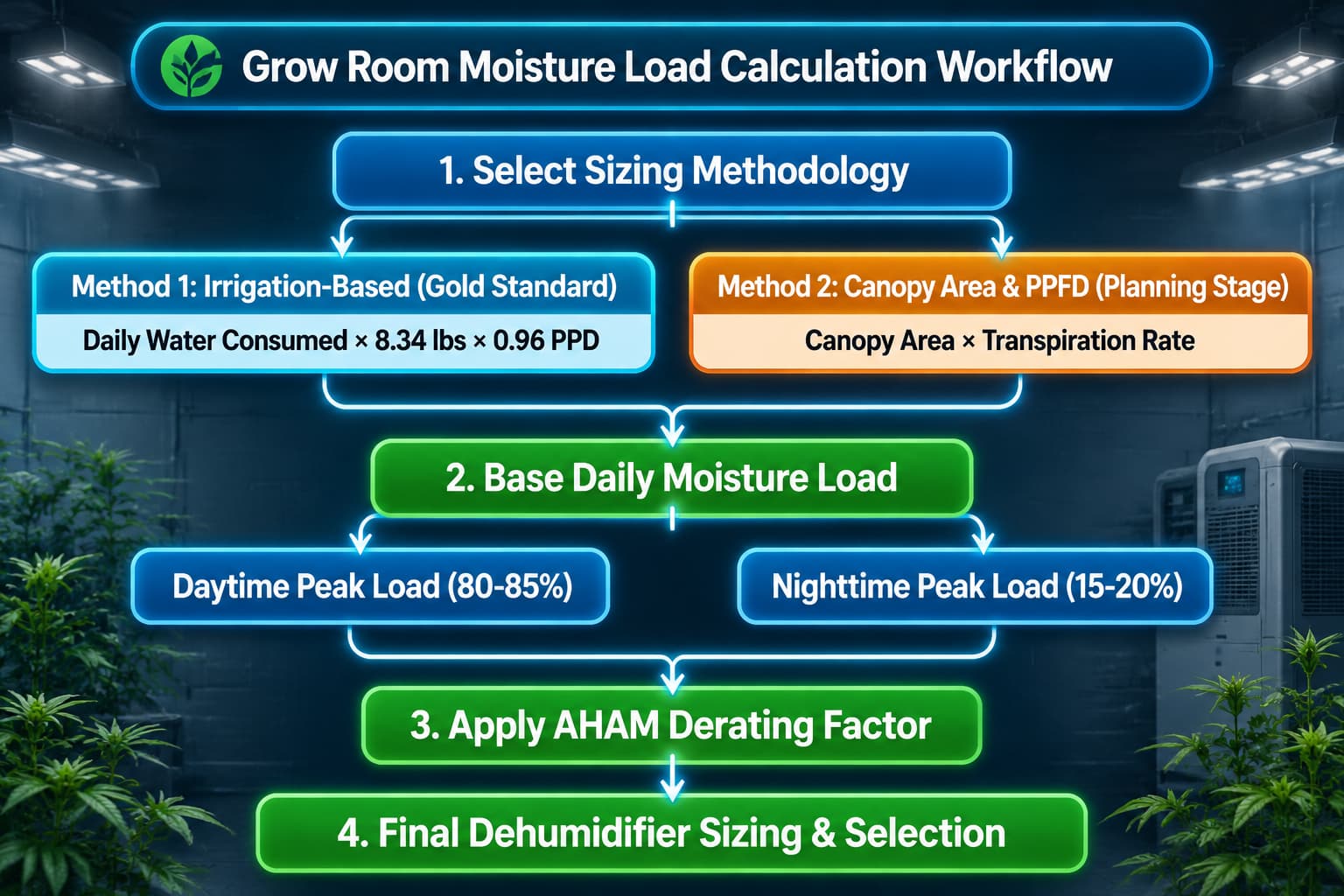
One of the most widespread engineering mistakes in CEA facility design is sizing dehumidification solely on a 24-hour daily average.
Sensible Heat Extinction: When high-wattage grow lights turn off, sensible heat input drops instantly. Air temperature in the room drops rapidly (e.g., from 78℉ down to 68℉).
Psychrometric Capacity Collapse: Cooler air holds significantly less water vapor at saturation. As temperature drops, relative humidity spikes toward 100% RH (condensation/ dew point) even if no new moisture is added.
Stomatal Inertia: Although plant stomata close in the dark, they do not close instantaneously. For the first 30–60 minutes of the dark cycle, residual root pressure and warm canopy temperature cause continued high transpiration.
Substrate Evaporation: Warm, wet substrate media (coco/rockwool) continues off-gassing vapor into the cooling room air.
In a standard 12/12 photoperiod flowering cycle:
Daytime Transpiration Share: 80% to 85% of total daily moisture is transpired during the 12-hour lights-on period.
Nighttime Transpiration Share: 15% to 20% of total daily moisture is transpired during the 12-hour lights-off period.
Hourly Extraction Rate Requirements:
Daytime Hourly Load (Pints/Hour)= Total Daily PPD×0.825 / Lights-On Hours (e.g., 12h)
Nighttime Hourly Load ( Pints/Hour ) = Total Daily PPD × 0.175 / Lights-Off Hours (e.g., 12 h)
Engineering Takeaway: While the daytime hourly moisture load is higher, the nighttime operating conditions are psychrometrically more difficult because lower ambient air temperatures ( 65℉- 70℉) reduce dehumidifier extraction efficiency.
A critical source of system failure is directly matching manufacturer spec-sheet capacity to real grow room conditions.
What is AHAM?
Standard commercial dehumidifiers are rated at AHAM conditions: 80℉ (26.7℃) and 60% RH
Real Grow Room Operating Conditions
Vegetative Stage: 78℉/65% RH→ Performance is ≈100% to 105%≈100% to 105% of AHAM.
Mid Flower Stage: 75℉/50% RH→ Performance drops to ≈75% to 80%≈75% to 80% of AHAM.
Late Flower / Flush: 68℉/45% RH→ Performance drops to ≈55% to 62%≈55% to 62% of AHAM.
Derating Correction Formula
To ensure your facility hits target RH during the demanding late-flower phase, apply an equipment derating factor (Fderate):
Required Rated AHAM Capacity (PPD)= Actual Peak Moisture Load (PPD) /Fderate
Where Fderate = 0.70 to 0.75 for standard mid-flower targets, and 0.58 to 0.62 for late-flower cold/dry targets.
1). Facility Parameters:
Room Dimensions: 30 ft×40 ft×12 ft (14,400 cu. ft.)
Active Canopy Area: 800 sq. ft. (50 high-efficiency 680W LED fixtures)
Target Room Conditions: 75℉ (23.9℃) and 50% RH (VPD ≈1.40 kPa)
Daily Fertigation Volume: 160 Gallons/Day
Runoff Management: Automated bench trays with plumbed drain-to-waste (15% average runoff = 24 Gallons)
2). Calculation Steps:
Net Water Transpired into Air: Wtranspired=160 gal−24 gal=136 Gallons/Day
Actual Peak Daily Moisture Load: Actual Load = 136 gal × 8.34 lbs/gal × 0.958 Pints/lb × 1.05 (safety buffer) ≈ 1,142 PPD (540 L/Day)
Hourly Staging Loads:
Daytime Peak (12h): 1,142 × 0.825 / 12 = 78.5 Pints/Hour
Nighttime Load (12h): 1,142 × 0.175 / 12 = 16.6 Pints/Hour
Apply AHAM Derating Factor: At 75℉/50% RH, the derating factor Fderate≈0.78
Required AHAM Equipment Capacity = 1,142 PPD / 0.78=1,464 PPD (AHAM)
Equipment Selection:
Deploy 5 units of PRO300 Commercial Grow Room Dehumidifier (300 PPD AHAM each =1,500 PPD total capacity).
Result: Provides optimal multi-point air circulation across the canopy, built-in N+1 redundancy, and staggered staging to prevent compressor surges during night transitions.
1). Facility Parameters:
Canopy Area: 2,000 sq. ft. under 120 high-output LED fixtures
Peak Irrigation Target: 0.20 gal/sq.ft/day=400 Gallons/Day
Plumbed Runoff: 10%=40 Gallons/Day
Net Water Transpired: 360 Gallons/Day
Target Room Conditions (Ripening): 70℉ (21.1℃) and 45% RH45% RH
2). Calculation Steps:
Actual Daily Moisture Load: Actual Load = 360 gal × 8.0 Pints/gal = 2,880 PPD
Apply Late-Flower Low-Temperature Derating: At 70℉/45% RH, Fderate ≈ 0.62.
Required AHAM Equipment Capacity = 2,880 PPD / 0.62 = 4,645 PPD (AHAM)
Equipment Selection & Redundancy Layout:
Distributed Approach: 16 units of PRO300 (300 PPD each =4,800 PPD AHAM), distributed in a dual-tier racetrack air pattern.
Central Ducted Approach: 2 units of CFZ20 Industrial Heavy Duty Dehumidifier combined with ducted Guard120 sub-zone air handlers.
Selecting the right physical configuration ensures uniform airflow without hot spots or stagnant microclimates.
Core Models: PRO300 (300 PPD AHAM / 142 L/Day)
Key Features: High-efficiency rotary/scroll compressor, corrosion-proof epoxy coil coatings, digital humidistat, daisy-chain central controller compatibility (TrolMaster / BMS via RS485), and high-COP performance (>3.0 L/kWh).
Best For: Commercial indoor bloom rooms, vegetative rooms, and high-density vertical racks requiring direct canopy air circulation.
Core Models: Guard120 Ceiling Mount Dehumidifier (120 L/Day AHAM)
Key Features: Low-profile ceiling suspension, high external static pressure (ESP) blowers for ducted distribution, washable MERV 11/13 filtration.
Best For: Cleanroom cultivation suites where floor space is fully dedicated to benches and zero equipment footprint is permitted.
Core Models: CFZ10 and CFZ20 Industrial Refrigerant Systems (200 to 500+ L/Day)
Key Features: Heavy-gauge galvanized steel frame, large centrifugal air movers, integrated hot gas bypass defrost for continuous low-temperature drying.
Best For: Bulk processing rooms, large curing/drying warehouses, and post-harvest storage facilities.
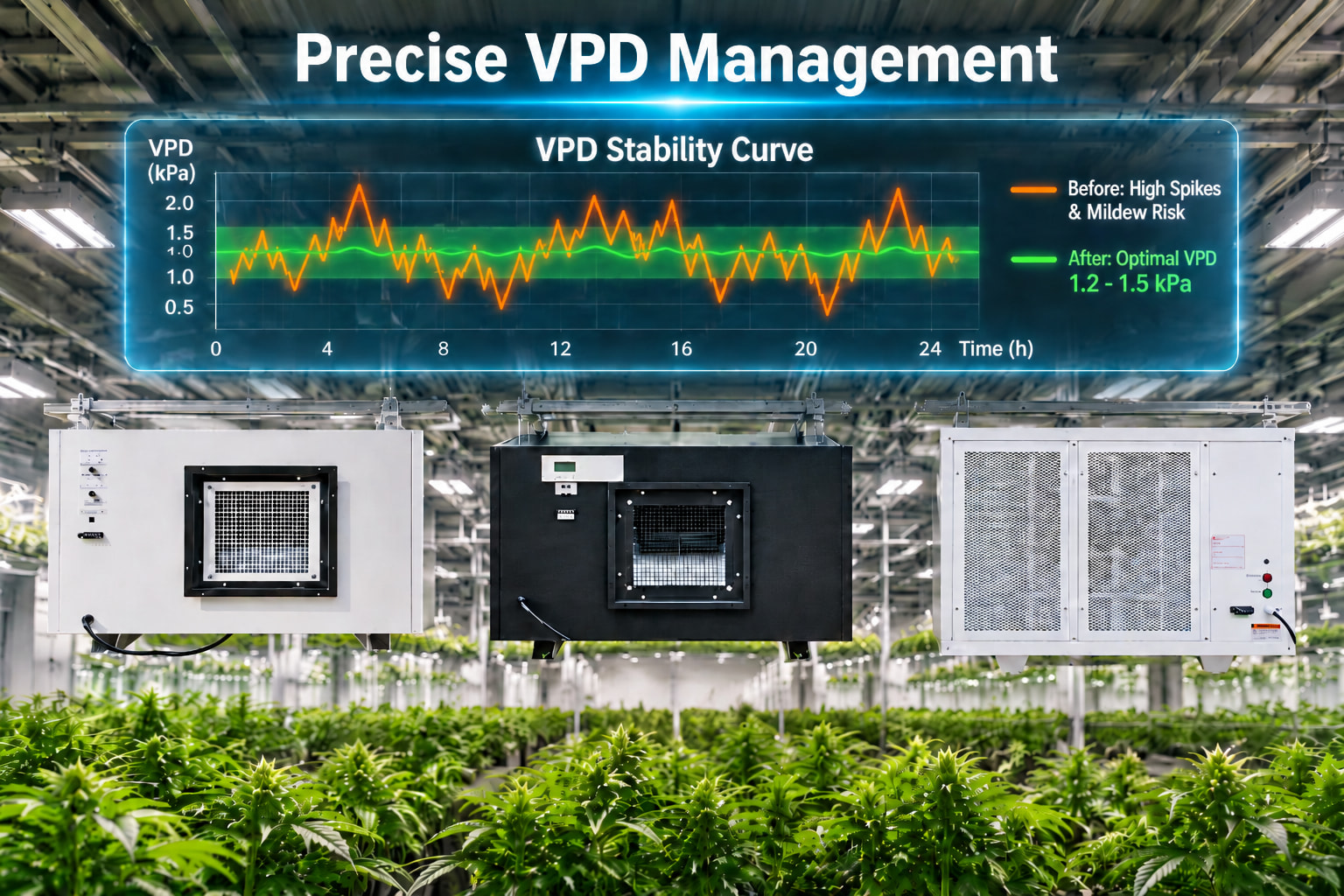
Accurate moisture calculation is only half the battle; proper air distribution ensures water vapor reaches the dehumidifier coils without forming localized humid microclimates.
Position distributed dehumidifiers along the perimeter walls to create a continuous "racetrack" air circulation pattern. Ensure dehumidifier supply discharge does not blow directly onto high-transpiring plant tops (to avoid wind burn / localized stomatal closure).
Never rely on the dehumidifier’s onboard return-air sensor alone for room-wide control.
Place aspirated sensor boxes (shielded temperature/RH probes with continuous mini-fans) at canopy level in the center of the bench array.
Connect distributed units to a master environmental controller via Modbus/0-10V signal to stage compressors sequentially rather than firing all units simultaneously.
Answer: In high-efficiency LED setups (650 W - 800 W fixtures with active CO2 supplementation), budget 20 to 30 PPD of AHAM dehumidification capacity per LED fixture or approx. 1.5 to 2.0 PPD per square foot of illuminated canopy). This accounts for real-world derating during the late-flower 50% RH phase.
Answer: Standard commercial AC units only extract moisture (latent cooling) when their compressors run to satisfy sensible temperature demands. When grow lights turn off and the room cools, the AC stops running completely—leaving 100% of the lights-off moisture load unaddressed. Dedicated commercial dehumidifiers operate independently of sensible temperature cooling demands, guaranteeing uninterrupted humidity control 24/7.
Answer: AHAM capacity is tested at 80℉/60% RH, which serves as the global engineering benchmark. Saturation capacity is tested at 90℉/90% RH (a warm, swampy condition rarely present in a functional grow room). Marketing materials often promote the inflated saturation number; always verify engineering sizing against AHAM-rated PPD.
Answer: VPD measures the drying power of the air—the difference between the vapor pressure inside the leaf's saturated internal cavity and the vapor pressure of the ambient room air. As plants transpire, ambient vapor pressure rises, and VPD decreases. Dehumidifiers extract water vapor to lower the room's ambient vapor pressure, maintaining the driving force necessary for continuous nutrient transpiration.
Answer: Yes. HONGTAI is an established OEM ODM manufacturer specializing in commercial and industrial dehumidification. We offer custom-branded grow room dehumidifiers equipped with high-COP compressors, ETL/UL/CE certifications, dual-voltage power supplies (110V/60Hz, 220V–240V/50Hz–60Hz, 277V, 460V), custom powder-coated casings, and seamless integration with leading CEA environmental controllers.
Accurately calculating grow room moisture load is the cornerstone of a profitable, biosecure, and energy-efficient commercial CEA facility. By basing calculations on actual irrigation water volume, accounting for the lights-off humidity spike, and applying temperature derating factors, facility engineers and growers ensure resilient climate control throughout every crop cycle.
Need professional equipment sizing verification, submittal drawings, or custom OEM/ODM commercial dehumidifier manufacturing?
Contact the HOGNTAI engineering team today at Hzhongtai.com for factory-direct technical consultations and B2B project quotations.


